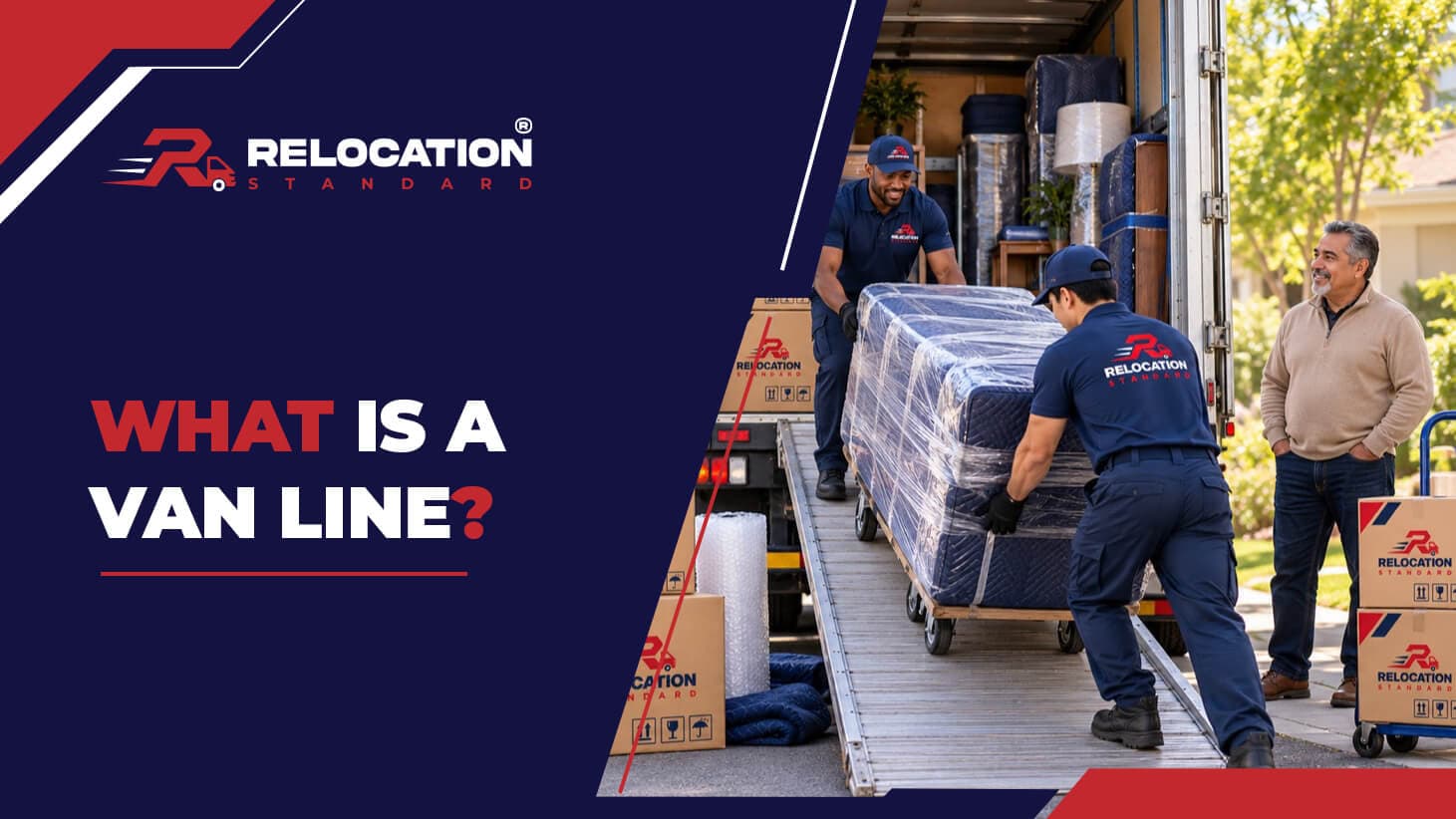
What Is a Van Line in Moving?
A van line is a moving organization that coordinates household-goods transportation through a network of affiliated agents, drivers, and operational resources. In a typical arrangement, local moving companies handle activities such as booking, surveys, packing, and pickup, while the van line's transportation system moves shipments across regions or state lines. The network may also assign a local agent near the destination.
The FMCSA glossary defines an agent as a local moving company authorized to act for a larger national company. United Van Lines and Mayflower both describe agent roles in their moving glossaries. The precise ownership and contracting model varies; a van line agent is not automatically a franchisee, and not every employee or truck is owned by the same company.
How a Van Line Move Works From Start to Finish
1. Booking and surveying
A local agency or booking office may take your inquiry, survey belongings, explain packing options, and prepare an estimate on the responsible mover's behalf. Confirm whether you received a binding estimate or a non-binding estimate, and make sure the listed goods and services match what you intend to ship.
2. Origin services
An origin agent may coordinate packing, pickup access, inventory, and local labor. A separate hauling agent or driver may arrive with the truck. Ask whether the shipment will remain on one vehicle or may be transferred, and document the condition of furniture and cartons before loading.
3. Long-distance transportation
The carrier arranges transportation along its network. Some shipments travel directly; others may be consolidated with other customers' shipments or transferred between equipment under the applicable arrangement. If more than one carrier participates in an interline move, the shipment documents should identify the participating carriers when known. Do not confuse a change of driver with a change of legal carrier.
4. Destination services
A destination agent may assist with local unloading labor, building access, storage coordination, or delivery questions. The agent is a useful local contact, but the transportation contract and carrier's obligations still matter. Keep the shipment number available whenever you call.
Van Line Versus Independent Moving Company
An independent mover may operate its own crews and trucks without a national agent network. A van line uses coordinated resources that can provide wider geographic coverage. Neither model guarantees a better experience. An independent carrier may offer direct communication; a van line may have more local agents and route options. Service quality depends on the actual carrier, agent, crew, contract, and planning.
A moving broker is different again: it arranges transportation but generally does not physically move the goods. A van line network may involve several affiliated agents without being a broker transaction. Verify the legal entity shown on your bill of lading and the registered carrier's USDOT number instead of judging solely by the number of company names involved.
Who Is Responsible if Something Goes Wrong?
The responsible interstate motor carrier is identified through the transportation documents and applicable law. An agent may help investigate a missing carton or arrange a local crew, but that does not automatically make the agent the party responsible for paying a claim. The FMCSA general requirements define movers to include carriers and their household-goods agents, and FMCSA guidance addresses written agreements with prime agents.
If an item is damaged, preserve the signed inventory, delivery paperwork, photographs, and correspondence. Submit a proper written claim through the carrier's damage claims process. If delivery is late, check the agreed delivery window and any guaranteed-service terms before assuming a particular remedy applies.
How Are Van Line Moves Priced?
Pricing depends on the mover's tariff and estimate, shipment size or weight, distance, access conditions, services, timing, and chosen valuation. A van line may quote transportation and packing separately or include various services in a bundled price. There is no universal van-line fee or nationwide fixed rate simply because the company belongs to a network.
Consider a hypothetical 4,000-pound interstate shipment with a $4,200 transportation charge, $600 packing service, and $150 for a properly disclosed special service. The illustrative total would be $4,950 before any other applicable charges. Those amounts are examples only. Ask how the estimate is calculated and whether the moving tariff includes accessorial charges or peak-season rates.
Questions to Ask a Van Line Before Signing
Ask for the carrier's legal name and USDOT number, the booking agent's name, and the likely origin and destination agents. Confirm who will pack, load, haul, unload, and process claims. Ask whether goods may be transferred to another truck or temporarily placed in storage-in-transit, and what that means for inventory tracking and charges.
Review the order for service, bill of lading, pickup date, and delivery spread. If the salesperson promises exclusive truck use or a guaranteed date, insist that the premium service and any remedy be documented. Verify the carrier using FMCSA's registered mover search.
Example: A Three-Office Interstate Move
Suppose a customer moving from Seattle to Nashville contacts a Seattle van line agent. That office books the shipment and supplies packing labor. A long-distance driver from another affiliated agency hauls the goods. A Nashville-area destination agent arranges an unloading crew. The customer sees several local company names, but the shipment still needs one clear transportation contract and a responsible carrier.
The important questions are whether each participant's role was disclosed, whether the shipment is inventoried and tracked, and whether the carrier's delivery and claims obligations are clear. A multi-agent arrangement can be legitimate without requiring the customer to guess who holds the goods.
Final Takeaway
A van line connects local moving resources with long-distance transportation. The arrangement can make interstate moves practical across many cities, but it works best when the customer knows the responsible carrier, each agent's role, and the agreed services. Verify those details before signing, and keep all changes in writing. For planning, explore Relocation Standard's long-distance movers and residential moving services.