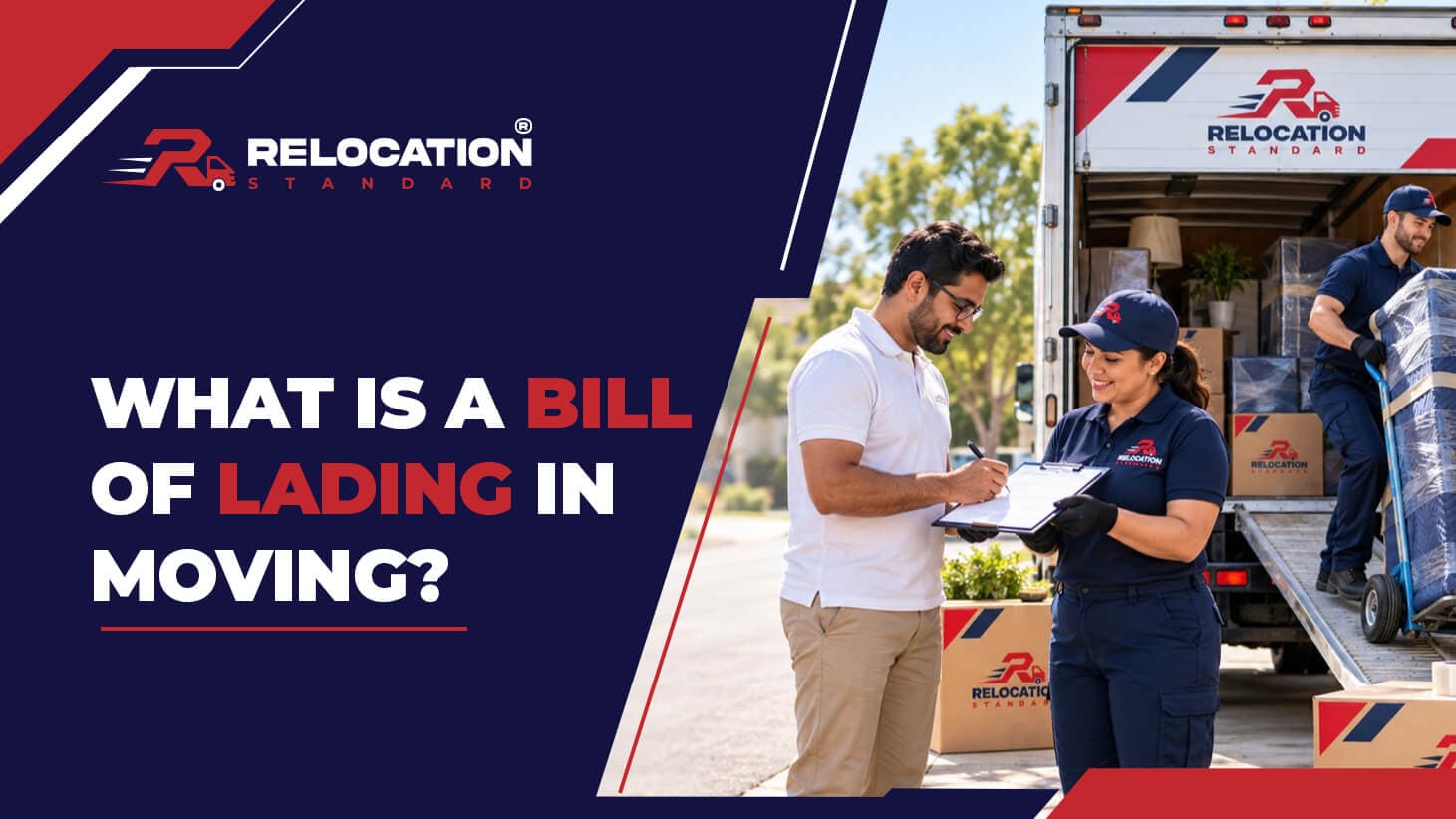
What Is a Bill of Lading in Moving?
A bill of lading (BOL) is the transportation contract between the moving carrier and the shipper and a receipt for the household-goods shipment. It identifies the responsible mover, shipment, services, pickup and delivery arrangements, payment terms, and relevant liability provisions. The federal interstate requirements appear in 49 CFR § 375.505.
For example, a Chicago-to-Dallas household move may have a BOL documenting the pickup and delivery arrangements, the carrier's identity, the estimate, and the amount that may lawfully be demanded at delivery. The signed contract is important if there is a disagreement about delay, charges, or missing goods.
What Information Must the Bill of Lading Include?
Under the federal interstate household-goods rules, a BOL contains a detailed set of required fields. The most important information includes the carrier's legal or registered trade name and physical address; customer identification and contact information; participating carriers when known; actual pickup date; vehicle and shipment identification; agreed pickup and delivery dates or periods; services and charges; payment method and delivery payment limit; valuation statement; and required attachments and incorporated contractual terms.
Basic illustrative BOL summary
| Field | Example, not a compliant form |
|---|---|
| Carrier | Example Interstate Movers LLC |
| Customer | Sample Customer |
| Pickup | Chicago, IL |
| Destination | Dallas, TX |
| Agreed delivery range | June 13–18 |
| Estimate type | Binding |
| Covered estimate | $3,800 |
| Attachments | Inventory and estimate |
A real federal BOL contains more information and legally required statements than this summary. Compare its details with your binding estimate or non-binding estimate before signing.
When Must You Sign It?
Under the current federal interstate household-goods rule, the BOL generally must be provided to the customer for signing and dating at least three days before scheduled loading. The rule also generally provides a three-day penalty-free rescission period after signing. A specific exception applies to qualifying changes in items or services on moving day; those changes do not create another three-day window. The BOL must be properly signed at both origin and destination.
Some details, such as actual shipment weight, cannot reasonably be known before loading. Those may be completed later within regulatory limits. A mover may not require a customer to sign a completely blank document. Get a dated copy of what you sign and keep it accessible during travel.
Bill of Lading vs. Order for Service
Historically, an order for service documented authorized moving arrangements while the BOL provided the transportation contract and receipt. In 2022, FMCSA removed the separate federal order-for-service requirement and consolidated the required information into the bill of lading, with a later technical correction in 2023. Some movers may still use an additional order-for-service form, and state requirements may differ. Older guides suggesting every interstate mover must issue a separate federally mandated order for service are outdated.
Our future guide to orders for service will discuss the historic terminology and current differences.
Bill of Lading vs. Moving Inventory
The BOL establishes the contract; the moving inventory list records every carton and uncartoned article and may note item condition. For regulated interstate household-goods moves, the mover must prepare the required inventory and give the customer an opportunity to review and verify it. At delivery, you can use the inventory to mark items that are missing, damaged, or destroyed.
| Document | Primary role |
|---|---|
| Bill of lading | Contract and shipment receipt |
| Moving estimate | Expected or agreed charges for the listed services |
| Inventory | Itemized shipment and condition record |
| Freight bill | Charges billed for the move |
The estimate and inventory may be incorporated as attachments. A BOL is not a replacement for an accurate inventory or a detailed charge calculation.
Does the Bill of Lading Guarantee the Price?
No. The estimate type determines whether the listed charges are fixed. Under a binding estimate, the covered amount generally remains agreed unless valid extra services or changes apply. Under a non-binding estimate, lawful charges can depend on actual shipment weight and services under the moving tariff. The federal 110% rule generally limits the amount collectible at delivery toward the originally estimated services under a non-binding estimate; it does not cap the entire final bill.
Ask the mover for an itemized explanation of accessorial moving charges and the amount due at delivery. A delivery window documented in the BOL is not automatically a guaranteed delivery date.
How Does the BOL Affect Valuation?
For interstate household goods, the mover must provide valuation options. Full Value Protection is a more comprehensive measure of carrier responsibility, subject to the agreement; Released Value Protection generally limits liability to 60 cents per pound per article. Valuation is not the same as independently purchased insurance. Review the valuation statement and don't sign a waiver without understanding the financial consequences.
What Should You Do at Delivery?
Compare boxes and furniture against the inventory and photograph obvious problems. Note missing or damaged items on the appropriate delivery documents, retaining copies of the exceptions. Review any acknowledgment before signing; don't declare everything is in perfect condition if it isn't. Keep the BOL, inventory, estimate, freight bill, and communications together until all payments or claims are resolved.
What to Check Before Signing
- Verify the identity of the carrier that will actually transport the goods, not just a broker.
- Confirm both addresses, pickup and delivery arrangements, and contact information.
- Compare the estimate and service scope, including packing, storage, and specialty items.
- Review the maximum amount due at delivery and accepted payment methods.
- Check the valuation statement and attached inventory.
- Keep dated signed copies in accessible storage.
Final Thoughts
The bill of lading governs the shipment, not just the paperwork. Review it in advance, compare it with your estimate and inventory, and retain it through delivery and any disputes. Explore interstate moving services and long-distance moving options for help planning a household relocation.