Stair fees are not automatically improper, but they should not be a mystery on moving day. Understanding what counts as a stair carry, when the charge applies, and how it differs from other fees can help you compare estimates and avoid preventable disputes.
What Is a Stair Carry Fee in Moving?
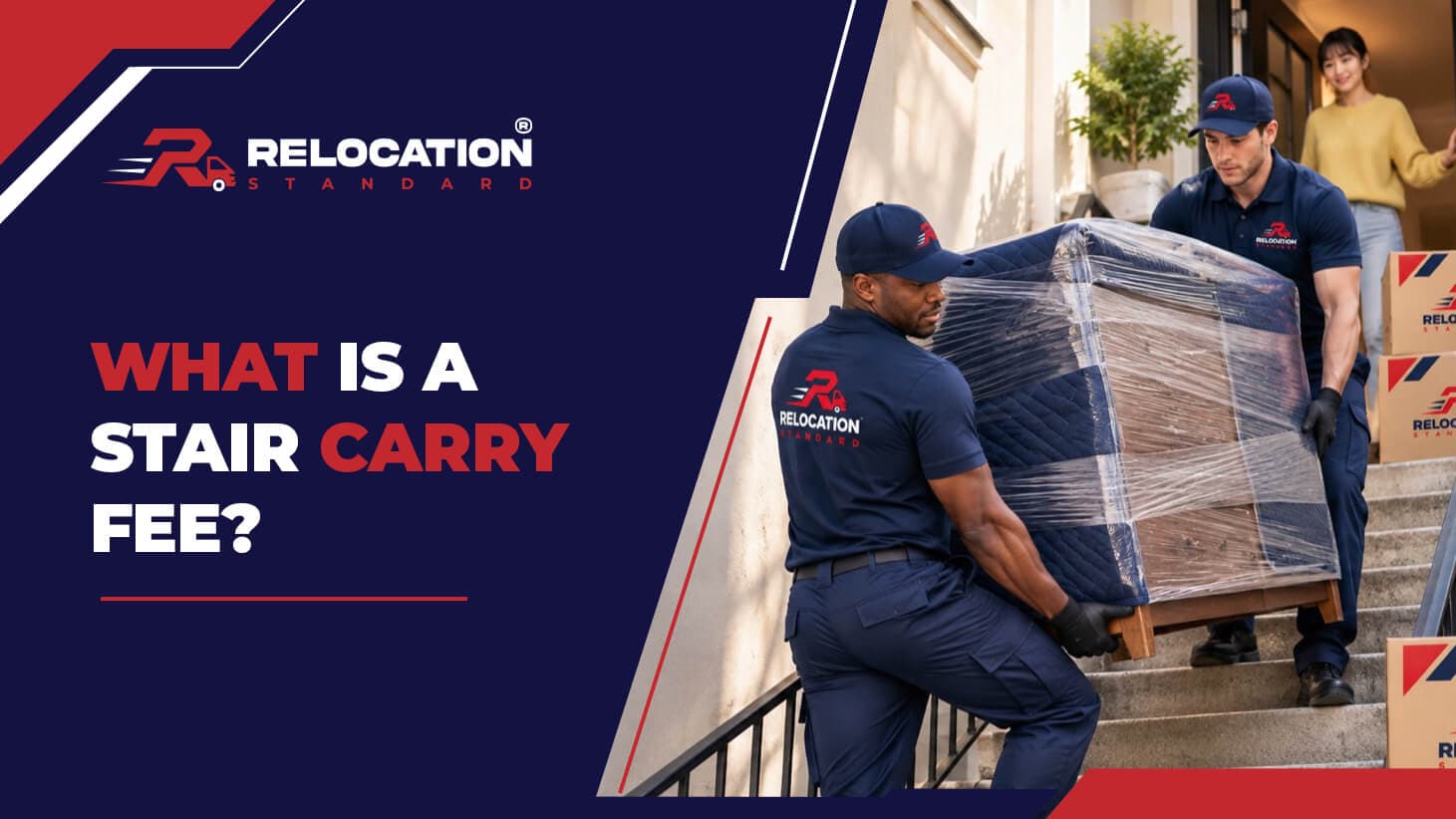
A stair carry fee is an additional charge some moving companies assess for carrying household goods up or down flights of stairs at the pickup or delivery location. It compensates for extra handling, labor, and time associated with stair access.
For example, suppose your new apartment is on the fourth floor and the building has no elevator. Movers may need to carry boxes, furniture, and appliances up several staircases. The mover's tariff or written agreement may authorize a separate charge for that work.
The FMCSA moving glossary defines a flight charge as an extra charge associated with carrying items up or down stair flights. Industry sources such as Allied Van Lines' moving terminology use the same general definition.
A stair carry is a form of accessorial service when it is separately chargeable. A local mover may instead account for stair handling through its hourly labor rate. There is no universal federal stair fee or nationally mandated price per flight.
Why Do Movers Charge for Stairs?
Moving heavy belongings through stairways creates work that often is not present in a ground-floor move. A crew may need to carry items farther vertically, coordinate carefully around landings, and take additional steps to prevent damage to walls and furniture.
Large couches, mattresses, appliances, and wardrobes may require two or more crew members to navigate turns and narrow landings. Loading may also take longer when every box must travel several flights before reaching the truck.
Some companies treat the extra handling as a separate charge; others include it in a broader origin-and-destination service fee or the quoted hourly labor. United Van Lines' glossary, for example, describes origin and destination service charges that can include ordinary stair-related work under its pricing arrangements. The important question is what the particular mover actually includes, not whether the stairs exist.
When Does a Stair Carry Fee Apply?
A fee may apply when the shipment must be moved up or down stairs and the move meets the company's tariff or contract conditions. Common examples include the following.
Walk-up apartments
Walk-up buildings without elevators can require crews to carry belongings to upper floors. A third- or fourth-floor unit may involve several flights at both the origin and destination if both properties are walk-ups.
Houses with exterior steps
A home may have stairs leading from the driveway or sidewalk to a raised porch. Some movers include a small number of steps in the regular service; others define separate rules. Ask what the contract means by a "flight" before assuming a few porch steps trigger a fee.
Split-level and multistory homes
A moving crew may need to move furniture between levels inside a residence. Whether the internal stair use is separately charged can depend on the carrier's service definition and inventory survey.
Basement and attic access
Heavy appliances or stored belongings carried up basement stairs or down from an attic may involve extra handling. Show these areas during the survey; a room-by-room inventory that ignores a basement is incomplete.
Elevator outages or restrictions
If a building normally has a functioning service elevator but it becomes unavailable, movers may need to use stairs. Additional charges and their timing depend on the circumstances and the agreement. A stair charge should not simply be presumed valid because an elevator is temporarily out of order.
Specialty items on staircases
A piano, safe, large piece of glass, or bulky appliance may require a specialized crew, additional equipment, or a different handling plan. The charge may be classified as a stair carry, a specialty-item fee, or another tariff provision. If both fees are proposed, ask what distinct work each charge covers.
What Counts as One Flight of Stairs?
There is no single nationwide definition for pricing purposes that every moving company must use. A carrier may count flights, landings, stair segments, or another unit defined in its tariff. Some moving firms include an allowance before charging anything.
For example, one company may consider a full level between floors to be one flight. Another may have a tariff that treats a staircase with a landing as two segments. A third may price the service by crew time rather than by flight.
Because these approaches differ, ask the mover three questions before accepting an estimate: How many flights did you count, how does your tariff define each flight, and which flights are already included?
Are a few front-door steps a stair carry?
Not necessarily. A porch with several steps is not automatically priced the same as a three-story walk-up. The applicable contract should make clear whether there is an included allowance or a charge for the specific configuration.
Do stairs count at both addresses?
They may. If the crew must carry belongings down two flights at pickup and up three flights at delivery, the mover may calculate separate services at each address when permitted by its tariff. A complete survey should consider both sides of the move.
How Much Is a Stair Carry Fee?
There is no universal price, and online estimates should not be treated as guaranteed national rates. The calculation may use a flat charge, a per-flight charge, labor hours, weight, or another rule in the mover's published tariff or local contract.
Example 1: A per-flight calculation
Suppose a hypothetical interstate carrier includes the first flight at each residence and charges $45 for each additional billable flight. The customer moves from a ground-floor home to a fourth-floor apartment with three flights counted under that hypothetical tariff.
| Hypothetical item | Amount |
|---|---|
| Number of flights counted at destination | 3 |
| Flights included under the assumed allowance | 1 |
| Additional billable flights | 2 |
| Rate per additional flight | $45 |
| Illustrative stair carry fee | $90 |
This is an invented pricing example, not an industry average or Relocation Standard price. Another mover may define the included allowance, billing units, or charges differently.
Example 2: Extra time on a local hourly move
Suppose a local mover charges $160 per crew-hour and the stair access adds 45 minutes to the job. If the contract bills in quarter-hour increments with no separate stair fee, that additional time would represent $120 in labor under this hypothetical arrangement.
The move may therefore cost more because of stairs even without an invoice line labeled "stair carry."
Example 3: Separate origin and destination charges
If your current apartment requires two billable flights and the destination requires three, a hypothetical $35 per-flight tariff would produce $70 at origin and $105 at delivery, for $175 total. The charge is not automatically correct in a real dispute; the estimate, actual flights, and tariff must support it.
Stair Carry Fee vs. Elevator Charge
A staircase charge and elevator-related charge describe different access circumstances. A stair fee concerns manual transport of belongings up or down flights. An elevator charge, when applicable under a mover's tariff, relates to using an elevator or its related handling requirements.
| Topic | Stair carry | Elevator service |
|---|---|---|
| Main access feature | Stairs between levels | Passenger or service elevator |
| Primary handling issue | Physical carrying between floors | Elevator access, loading, scheduling, and waiting |
| Typical example | Third-floor walk-up | High-rise with reserved freight elevator |
| How priced | Depends on tariff or hourly contract | Depends on tariff or hourly contract |
The presence of a working elevator does not guarantee a stair fee will be zero. For example, an oversized couch may not fit inside the elevator and may still have to be carried up stairs. Ask the crew to identify the reason and written charge before work begins where practicable.
Stair Carry Fee vs. Long Carry Fee
A stair carry concerns vertical movement on stairs, while a long carry fee concerns an excessive walking route between the truck and the building or residence. A building can require both services: imagine an apartment at the end of a long courtyard and three flights above the street.
A fee for stairs should not be confused with a shuttle service fee, which involves a smaller vehicle when the main moving van cannot reach the property. Ask the mover to identify the actual service performed for each additional line item.
Is a Stair Carry Fee Legal?
A separately charged stair carry can be lawful if the company has a proper basis under its tariff or local contract and follows the relevant rules. For federally regulated interstate household goods moves, the FMCSA recognizes flight charges as an additional service, but it does not set a universal charge or mandatory flight count.
The carrier must still meet its disclosure and estimate obligations. Under 49 CFR § 375.401, an interstate mover must prepare a written estimate based on the required survey, determine applicable accessorial services before preparing the bill of lading, and may not amend the estimate after loading.
The Surface Transportation Board's household goods tariff guidance explains that interstate household goods carriers must have tariffs stating rates, charges, and the conditions under which accessorial services apply. A company cannot simply invent a price at delivery without regard to those documents.
Should Movers Include Stair Carry Fees in the Estimate?
If stairs are known or can reasonably be assessed before the move, the mover should identify the relevant service and applicable rate when preparing the estimate. This is why you should mention stairs, elevators, walkways, internal levels, and bulky pieces during the survey.
Section 375.401(f) specifically requires interstate movers to determine applicable accessorial charges before the bill of lading is prepared. If the mover fails to ask about and determine those charges beforehand, it must deliver the goods and bill the shipper after 30 days for the additional charges under that provision.
This is a collection-timing protection; it does not automatically cancel every otherwise lawful fee. If the mover actually knew about the stairs and included the service in the estimate, an additional demand for the same covered work merits close scrutiny.
Can a Stair Fee Be Added After a Binding Estimate?
A binding estimate generally sets the agreed price for the listed belongings and services. If stair handling was included in the scope, the mover generally cannot charge again for that same covered work merely because it underestimated the labor.
If you add belongings or request different services before loading, federal regulations allow certain written changes to the estimate. Once the shipment is loaded, the estimate cannot simply be rewritten. Additional services requested after the bill of lading has been issued and certain unexpected operations are governed by separate rules.
At the destination, an unforeseen elevator failure or an incorrect building-access description may change the services required. The mover must still establish a lawful basis for any charge and comply with applicable notification, agreement, and payment rules. Do not accept an unexplained increase as automatically correct.
Can a Stair Fee Be Added to a Non-Binding Estimate?
A non-binding moving estimate is approximate. Lawful final charges can reflect the actual shipment and services under the mover's tariff. Stair access that qualifies for a separate tariff charge may affect the final price.
However, federal rules generally limit what may be required at delivery for originally estimated services to 110% of the non-binding estimate. That does not cap the final bill and does not remove separate treatment for certain additional services.
The 110% rule is not a stair fee formula
Suppose a non-binding estimate is $3,000. The general maximum collectible at delivery toward the original estimated charges is $3,300, assuming no separately permitted additional services. The 10% difference is a payment-protection calculation, not a surcharge the mover automatically earns for encountering stairs.
Does the 15% impracticable-operations rule apply?
Only when a service meets the definition of impracticable operations in the carrier's tariff and the federal requirements. Ordinary stair carries do not automatically qualify. Under 49 CFR § 375.703, qualifying impracticable-operations charges collected at delivery generally cannot exceed 15% of all other charges due at delivery. The remaining lawful amount is billed under separate federal rules.
For example, if all other lawful charges due at delivery are $4,000, the maximum amount collectible at delivery for qualifying impracticable operations would generally be $600. This is not a cap on ordinary stair fees and is not a universal maximum on the total amount of all additional services.
Can Movers Charge for Stairs They Did Not Use?
A charge for a service not performed should be questioned. Begin by comparing the invoice with the tariff and the actual access route. A mover may have an origin-and-destination service rate or minimum that isn't simply based on each stair used, so the answer depends on what the rate actually covers.
If your building has an elevator and the crew never used the stairs, request an explanation of the stair charge. Ask whether it relates to another portion of the move, a particular bulky item, or a different rate bundled under the same heading.
Photographs, elevator reservation confirmations, building rules, and a written inventory can help establish what access conditions were present.
How to Avoid Unexpected Stair Carry Charges
The most reliable way to avoid surprises is to disclose the details and ask about the pricing method before signing.
Show every staircase during the survey
Tell the mover about stairs outside the house, interior flights, basements, lofts, and the destination unit. Do not assume the consultant knows the building's layout from its street address.
Confirm the service elevator
For an apartment or condominium, ask management whether a freight elevator is available, what size it is, and whether it must be reserved. Verify that large furniture will fit, and share elevator dimensions if necessary.
Measure difficult furniture
A large sofa or mattress may not fit through a stairwell corner or elevator. Ask the moving company whether the item needs special disassembly, an alternative route, or additional handling. Do not attempt unsafe lifting to save a fee.
Identify parking and walking distances
Stair charges can coexist with long carry fees or shuttle service fees. Supply photographs of truck access and the entrance, not just the unit number.
Compare written estimates using the same facts
Give each mover the same inventory and building details. Ask whether its quote includes flight carries or incorporates them into a broader origin-and-destination service charge.
Ask for the tariff or rate provision
For interstate moves, request the portion of the carrier's tariff governing stair or flight charges. Confirm the billing unit and any allowance. Keep a copy of the estimate and the bill of lading.
How to Dispute a Stair Carry Fee
If you believe a charge is incorrect, begin with the moving company rather than assuming the entire invoice is invalid. Request an itemized calculation, the flight count or other measurement, and the relevant tariff or contract provision.
Compare the charge with the estimate and ask when the mover learned about the access condition. For interstate moves, ask whether the original estimate included the stair service and whether the timing of collection complies with 49 CFR § 375.401 and other applicable provisions.
If the company refuses to explain the rate, preserve the estimate, invoice, bill of lading, photographs, and messages. You can review its arbitration process for qualifying billing disputes and contact the Surface Transportation Board's rate dispute resources for questions about interstate tariff charges. Suspected federal moving violations may be reported through the FMCSA Complaint Center. A regulatory complaint does not guarantee reimbursement.
Do Stair Carry Fees Apply to Local Moves?
Yes, stair-related costs can arise in a local or intrastate move, although the federal interstate rules do not automatically apply. Some local movers include stair handling in the hourly crew rate. Others list a separate flight charge, additional-worker charge, or minimum.
For a short-distance apartment move, the time needed to navigate a stairwell can have a larger impact on labor hours than the driving time. When comparing local moving services, ask whether stairs affect the hourly rate, estimated duration, or an additional line item.
Final Thoughts
A stair carry fee, also called a flight charge, may apply when a moving crew must carry belongings up or down stairways beyond what the company's standard service covers. The amount is not set by one national rule; it depends on the tariff, estimate, and work actually performed.
For interstate household goods moves, federal rules require movers to identify applicable accessorial charges before preparing the bill of lading and regulate when additional amounts may be collected. The safest approach is to describe stair access at both locations, confirm what the quote covers, and keep the written documents.
To plan a move with multistory access, review Relocation Standard's residential moving services, local moving services, or long-distance moving services, and request an estimate that accounts for staircases, elevators, large furniture, and truck access.