A long carry charge is not a universal amount triggered by every hallway or driveway. The carrier's tariff or written agreement determines how distance is measured, what allowance applies, and how the charge is calculated. Understanding those details can help you get an accurate estimate and avoid a surprise on delivery day.
What Is a Long Carry Fee in Moving?
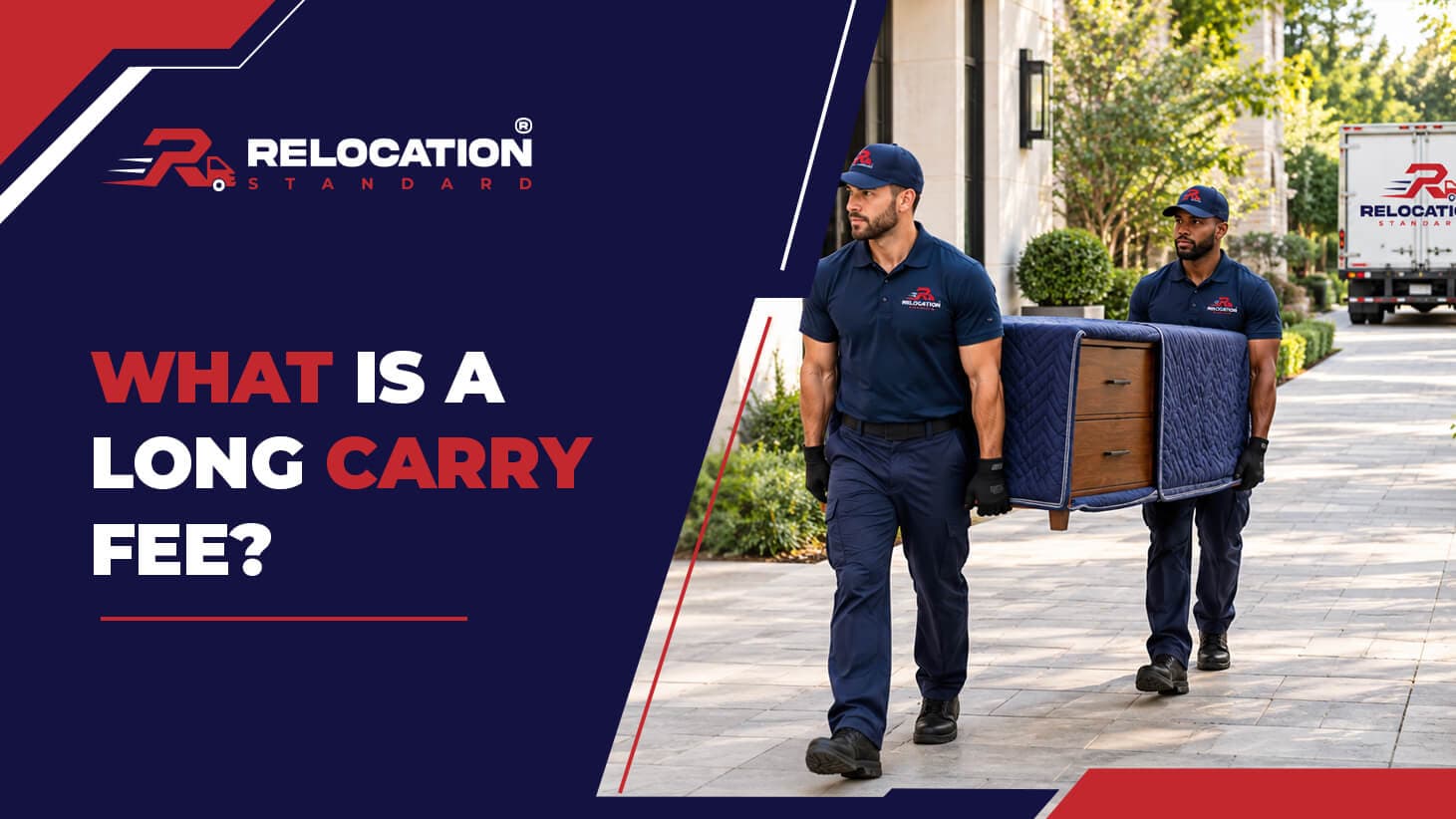
A long carry fee is an additional moving charge that may apply when workers carry household goods an excessive distance between the moving vehicle and the residence. It compensates the carrier for extra handling and labor beyond the included carrying allowance.
The FMCSA moving glossary defines long carry as a charge for carrying articles excessive distances between the mover's vehicle and the residence. It notes that these charges may be in addition to linehaul transportation charges.
For example, if a moving truck must park 200 feet from an apartment entrance and the carrier's tariff includes a shorter distance, the extra carrying route may trigger a charge. But the actual fee depends on the applicable measurement method and rate.
A long carry is generally a type of accessorial service. It is different from a shuttle fee, which involves using a smaller vehicle when the main moving truck cannot access the property.
When Do Movers Charge a Long Carry Fee?
The fee may apply at pickup, delivery, or both, depending on the conditions and the carrier's pricing terms.
Long apartment hallways
Large buildings may have extended corridors between the unit and the designated loading entrance. Even if the truck is parked near the building, the actual carrying route may be long.
Distant parking and loading zones
Street restrictions can prevent the truck from parking directly outside a home. The crew may need to carry belongings from the nearest legal loading location. The mover should not park illegally or block traffic simply to avoid the fee.
Long driveways
A driveway may be too narrow, steep, or weak for a loaded moving truck. If the vehicle remains near the street, the walking route to the house may exceed the standard allowance.
Gated communities
Some developments restrict large trucks or require loading at a designated entrance. If movers must carry belongings through the complex, the additional distance may be chargeable.
Courtyards and interior paths
A direct line from the street to the unit may be short, but the safe walking route may pass around landscaping, ramps, or building obstacles. Ask whether the tariff uses actual walking distance or another defined measurement.
Multiple pickup or delivery points
If belongings are collected from a garage, storage room, and residence, the mover may need to evaluate several carrying routes. An extra stop is a separate concept; ask how each service is priced.
How Many Feet Count as a Long Carry?
Many moving-industry examples refer to a 75-foot allowance, but 75 feet is not a universal federal threshold. Some carriers include a different distance, use another measuring point, or incorporate the service into a broader charge.
The applicable tariff determines whether the fee begins after 75 feet, 100 feet, another distance, or a different service condition. Do not assume a distance mentioned in an online article is part of your moving contract.
Example of a hypothetical 75-foot allowance
Suppose a fictional carrier includes the first 75 feet of carrying distance.
| Actual carrying route | Distance beyond allowance |
|---|---|
| 50 feet | 0 feet |
| 75 feet | 0 feet |
| 125 feet | 50 feet |
| 200 feet | 125 feet |
| 300 feet | 225 feet |
This table illustrates the arithmetic, not a national rule. The actual fee depends on whether the carrier bills per distance increment, by weight, by labor time, or another tariff method.
How Is Long Carry Distance Measured?
The measurement should follow the mover's tariff. One carrier may measure from the truck to the building entrance, while another may use the actual route to the residence or another defined point.
Ask whether the starting point is the rear of the vehicle, a loading ramp, or another reference point. Ask whether the endpoint is the building entrance, elevator, or apartment door. Interior corridors may count under some tariffs and be treated differently under others.
A straight-line map measurement may not reflect the route workers must walk. If the crew must follow a path around a courtyard or use a service entrance, the practical carrying distance can be longer than the direct distance.
Photographs, building maps, and a simple measurement of the actual path can help the carrier assess the situation before moving day.
How Much Does a Long Carry Fee Cost?
There is no nationwide fixed long carry price. The amount depends on the carrier's tariff, the actual carrying distance, the included allowance, and the pricing formula.
Example 1: Per-distance increments
Suppose a fictional tariff includes the first 75 feet and charges $60 for each additional 75 feet or portion. The actual walking route is 275 feet.
275 − 75 = 200 extra feet. Dividing 200 by 75 gives 2.67 increments, rounded up to 3 under this hypothetical tariff.
3 × $60 = $180.
The $180 figure is only an example. It is not a verified carrier price or a market average.
Example 2: Charges at both addresses
A different hypothetical tariff charges $50 per additional 75-foot increment after the first 75 feet.
| Location | Carry distance | Billable extra increments | Example charge |
|---|---|---|---|
| Pickup | 175 feet | 2 | $100 |
| Delivery | 225 feet | 2 | $100 |
| Total | $200 |
This shows why both addresses matter. An easy pickup does not guarantee an easy delivery.
Example 3: Hourly local pricing
A local mover may not list a separate long carry fee. If the extra walking route adds one hour to a crew billed at a hypothetical $150 per hour, the additional labor could be $150 under that contract.
Ask whether a separate long carry line can also be charged under the local agreement, or whether the hourly price already covers the work.
Long Carry Fee vs. Shuttle Fee
A long carry involves workers carrying items an extended distance on foot. A shuttle involves a smaller vehicle transferring goods because the main truck cannot reach the residence.
For example, a truck parked 200 feet away may require a long carry. If a large truck cannot enter the neighborhood and a smaller truck must transfer the shipment, a shuttle service may be needed instead.
A move could involve both services if the shuttle vehicle itself must park far from the unit. Each charge should reflect distinct work authorized by the tariff; the same service should not be billed twice without a legitimate basis.
Long Carry Fee vs. Stair Carry Fee
A stair carry fee concerns moving belongings up or down flights of stairs. A long carry concerns extended carrying distance along the relevant route.
A ground-floor apartment with a long corridor can trigger a long carry without stairs. A fourth-floor walk-up near the truck can involve stairs without a long carry. Some carrier tariffs bundle certain handling tasks, so check the written estimate before assuming both fees apply.
Are Long Carry Fees Legal?
Long carry fees can be lawful when assessed under the applicable tariff, written estimate, and governing law. A mover should not invent a fee after the fact simply because the crew walked farther than expected.
For federally regulated interstate household goods moves, 49 CFR § 375.401(f) requires carriers to determine applicable accessorial charges, including long carries, before preparing the bill of lading. If the carrier fails to ask about and determine such charges beforehand, the regulation requires delivery and billing after 30 days for the additional charges.
The Surface Transportation Board's tariff guidance explains that interstate household goods carriers must maintain tariffs describing their charges and when they apply. Request the long carry provision and calculation.
The regulation's deferred billing provision does not automatically eliminate a lawful charge. It affects when certain previously undetermined accessorial amounts may be collected.
Long Carries and Binding Estimates
A binding estimate generally guarantees the agreed price for the inventory and services identified in the estimate. If a long carry was already included, a second charge for the same work should be questioned.
If the customer adds items or services before loading, federal rules provide procedures for reaffirming or revising the estimate. The mover cannot freely amend the estimate after loading.
If an unexpected destination condition creates additional work, the contract and federal rules determine whether a separate charge may be assessed and when it is payable. Ask for the tariff basis and written documentation.
Long Carries and Non-Binding Estimates
A non-binding estimate approximates the final charges. For regulated interstate moves, actual weight, services, and tariff provisions determine the lawful bill.
Under the federal 110% rule, the carrier generally cannot require more than 110% of the non-binding estimate at delivery for the originally estimated services. If the estimate is $3,000, that usual delivery collection amount is $3,300. Lawful additional charges may be billed later, and different rules apply to certain additional services.
The 110% rule is not a universal cap on the final invoice and does not automatically make every unexpected fee collectible at delivery.
Does the 15% Impracticable Operations Rule Apply?
Not automatically. 49 CFR § 375.703 limits collection at delivery for services qualifying as impracticable operations under the carrier's tariff. Such operations generally involve physical conditions that prevent normal pickup or delivery with assigned road-haul equipment.
A long carry fee is not automatically an impracticable operation merely because the distance is excessive. The carrier's tariff definition and the actual circumstances must support that classification.
For qualifying operations, the maximum collectible at delivery is generally 15% of all other charges due at delivery. If those other charges total $4,000, the illustrative maximum collection for qualifying impracticable operations is $600. The lawful remainder may be billed later under the applicable rules.
This is a delivery collection limit, not necessarily a ceiling on the final lawful long carry charge.
How to Avoid or Reduce a Long Carry Fee
Reserve legal loading space
Ask building management whether a truck can use a designated loading area close to the entrance. Some locations require a parking permit or advance reservation.
Check truck access before booking
Share driveway width, street restrictions, gate rules, loading dock instructions, and other access conditions. A truck that cannot park near the property may create extra handling.
Measure the actual route
Walk the likely route from the legal parking spot to the residence and record the approximate distance. Include turns, courtyards, ramps, and interior hallways where relevant.
Ask how the tariff counts distance
Clarify the included allowance, start and end points, increment size, and whether the charge applies separately at pickup and delivery.
Compare alternatives
A smaller vehicle may reduce carrying distance but create a shuttle fee. Compare the total cost rather than assuming one service is automatically cheaper.
Request written confirmation
Ask the mover to identify expected long carries on the estimate. If the mover believes none will apply, request confirmation based on the access details you supplied.
How to Dispute an Unexpected Long Carry Charge
Request an itemized invoice showing the measured distance, included allowance, rate, and tariff provision. Compare the measurement with the actual walking route and the information provided during the survey.
If the company never asked about access, review 49 CFR § 375.401(f) and ask when the service was determined. If the mover claims impracticable operations, request the tariff definition and check the applicable delivery collection limit.
Preserve photographs, measurements, building rules, the estimate, bill of lading, and messages. For interstate tariff questions, consult the Surface Transportation Board's household goods resources. Suspected federal moving violations can be reported through the FMCSA Complaint Center. A complaint does not automatically settle a billing dispute.
Do Long Carry Fees Apply to Local Moves?
They can. Local movers may use separate long carry fees or charge the extra time through an hourly crew rate. The applicable state laws and contract govern the pricing and payment terms.
A local move may be only a few miles by road but still require extensive walking at an apartment complex. When comparing local moving services, ask how property access affects the total estimate.
Final Thoughts
A long carry fee is a charge for extra walking distance between the moving vehicle and a residence, not a standard penalty that automatically applies after 75 feet. The applicable tariff determines the allowance, measurement method, and price.
Describe both addresses accurately, confirm legal truck parking and building access, and request a written estimate that includes foreseeable handling. For a move involving long walkways or restricted access, explore Relocation Standard's residential moving services and long-distance moving services and ask for a quote based on the actual route your movers will use.