The important distinction is that large does not automatically mean separately chargeable. The mover's tariff or written pricing terms determine which items qualify, what work the charge covers, and how the cost is calculated. This guide explains the fee, the common examples, the difference between a bulky charge and a weight additive, and how to check an unexpected bill.
What Is a Bulky Item Fee in Moving?
A bulky item fee is an additional moving charge for transporting certain articles that are unusually large, awkward, low in weight relative to the space they occupy, or difficult to load and unload. In interstate household goods moving, the term bulky article charge commonly appears in a carrier's tariff.
The Federal Motor Carrier Safety Administration's moving glossary identifies pianos, cars, boats, snowmobiles, and campers as examples of bulky articles. It explains that charges may compensate the carrier for difficult handling, unusual bulk, or low weight density. The glossary also notes that an additional weight additive may apply in some cases.
United Van Lines' moving glossary similarly explains that some items, including motorcycles, hot tubs, and large televisions, require extra handling and may have specific charges in its tariff. These are examples of carrier practices, not a rule that every mover must charge for every item on the list.
A bulky item fee is generally a form of accessorial charge rather than the basic linehaul transportation charge. Ask whether it is already included in your written estimate before assuming it is extra.
What Items May Be Considered Bulky Articles?
A carrier's tariff defines the qualifying articles. The following examples are worth disclosing during the survey, even when you are unsure whether a fee applies.
Pianos and large musical instruments
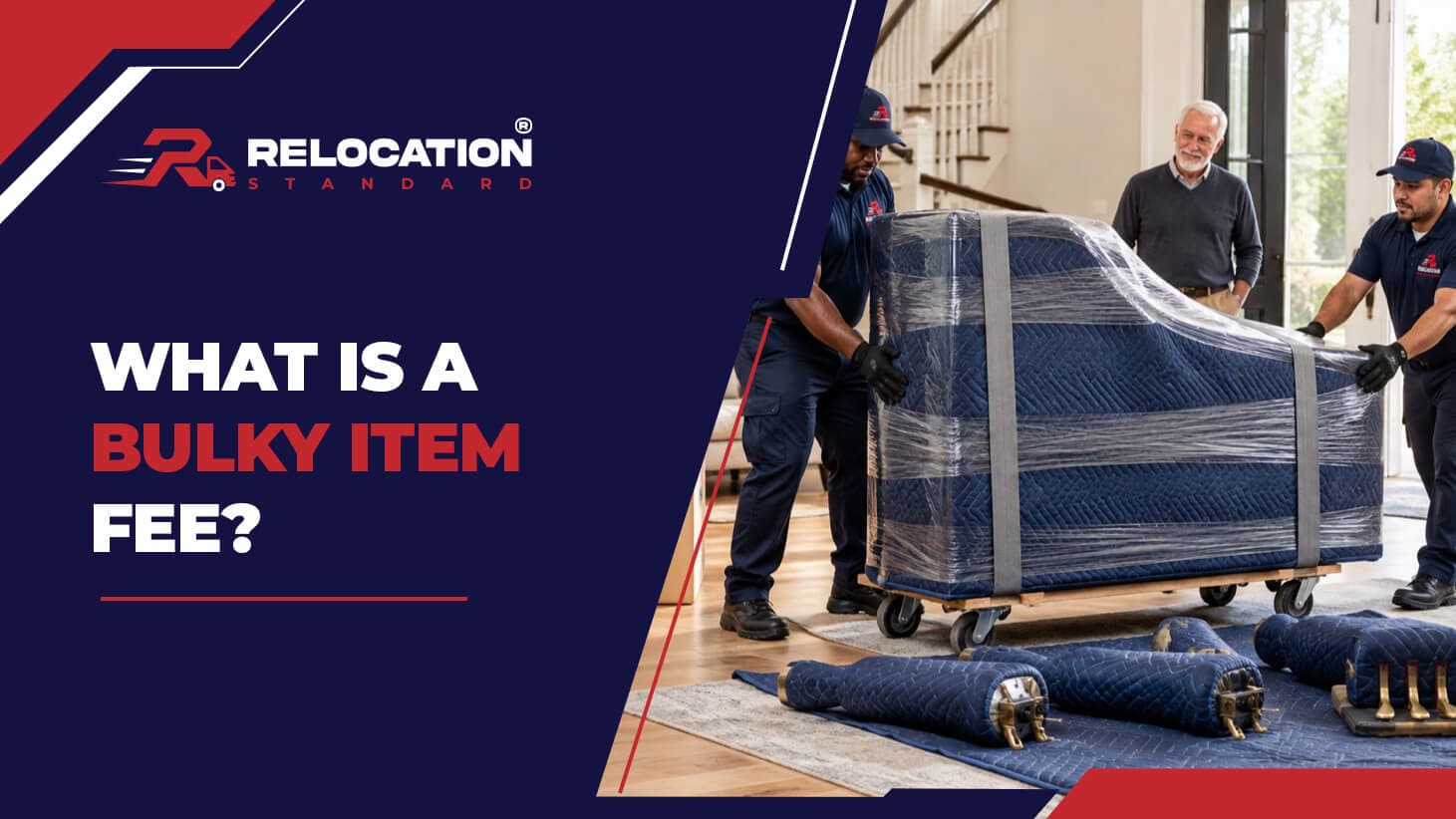
An upright piano can be heavy and difficult to maneuver. A grand piano may require legs to be removed, a piano board, protective wrapping, and an experienced crew. Some carriers have distinct piano-handling provisions rather than a generic bulky-item rate. Stairs, narrow doorways, and specialty crating can add separate services if authorized.
Motorcycles and recreational vehicles
Motorcycles, small recreational vehicles, and certain motorized equipment may need securement procedures, special loading equipment, or additional floor space. A household goods mover may decline to transport some vehicles or require preparation. Always confirm acceptance and the applicable tariff rather than assuming a motorcycle is covered by a regular furniture quote.
Boats, canoes, kayaks, and trailers
Long, lightweight articles can occupy space that would otherwise hold many cartons or pieces of furniture. A boat or canoe can therefore create a pricing issue even when it does not weigh much. Some tariffs use a weight additive to account for this space, a concept explained below.
Hot tubs and large exercise equipment
Hot tubs, oversized exercise machines, and assembled gym equipment can be bulky, heavy, or difficult to pass through doors. The mover may require disassembly, specialty equipment, or a separate crew. A fee for moving the item is not necessarily the same as a fee for disconnecting plumbing or electrical connections.
Large televisions and delicate displays
Very large televisions can be difficult to protect and load. A carrier may charge for specialized handling or packing materials. A television's size alone does not prove a bulky article fee applies; confirm whether the relevant tariff identifies that item.
Safes, pool tables, and oversized furniture
A heavy safe may require special equipment, and a slate pool table may need professional disassembly. These items are often discussed alongside bulky articles, but a mover may price them under specialty handling, crating, or third-party services instead. Ask for the precise service name and rate.
Why Would a Mover Charge Extra for a Bulky Item?
The fee can reflect a combination of handling difficulty, crew requirements, equipment, and truck capacity. A bulky item may need additional padding, securing straps, a loading ramp, or a careful route through the property. It can also occupy an unusually large part of the vehicle relative to its actual weight.
For example, a lightweight canoe may take up a long section of a moving van that could otherwise accommodate stacked cartons. A piano, by contrast, can create challenges because of its mass, balance, and susceptibility to damage. These are different reasons for additional charges, and the tariff may treat them differently.
The charge should be based on a stated pricing rule, not on an unverified claim that the item “looks difficult.” Under Surface Transportation Board tariff guidance, interstate household goods carriers maintain tariffs describing applicable rates, charges, and service terms. Ask for the relevant bulky article provision.
How Much Is a Bulky Item Fee?
There is no nationwide fixed bulky-item fee. The amount depends on the carrier's tariff, the type of article, and the work or service unit the tariff specifies. Some carriers publish a flat charge per qualifying article. Others may use weight additives, labor rates, or specialty-service pricing.
Example 1: Flat charge for a listed article
Suppose a hypothetical carrier tariff lists a $175 bulky article charge for a particular large item. If the shipment includes two qualifying articles and the tariff applies the charge to each, the illustrative extra amount is 2 × $175 = $350.
This is a fictional calculation. It does not establish a real carrier's rate or a market average. A different tariff could charge once for a category, use a weight-based formula, or include the handling in another service.
Example 2: Additional labor instead of a bulky fee
A local moving company might charge $160 per hour for a crew and bill an extra 45 minutes because a large piece of furniture requires careful maneuvering. Under an hourly arrangement, that additional time would represent $120 of labor. The company may not label the amount a bulky item fee at all.
Do not add a fictional flat bulky fee to an hourly estimate unless the contract authorizes both. The key question is which services are included and how the company prevents overlapping charges for the same work.
What Is a Weight Additive for Bulky Articles?
A weight additive is a tariff-defined adjustment that treats a qualifying bulky article as if it contributes additional weight for certain transportation charge calculations. It may be used when an article occupies much more van space than its actual weight would suggest.
United Van Lines describes this approach for items such as boats, canoes, and trailers. The FMCSA glossary also distinguishes a possible weight additive from the ordinary bulky article charge.
Example of a weight additive
Imagine a fictional tariff states that a certain oversized article carries a 500-pound weight additive for a specified transportation-rate calculation. If the actual household goods shipment weighs 4,500 pounds, the tariff might use 5,000 pounds as the chargeable weight for that specified purpose.
| Weight component | Hypothetical amount |
|---|---|
| Actual shipment weight | 4,500 lb |
| Tariff-defined bulky-item additive | 500 lb |
| Chargeable weight for the specified rate | 5,000 lb |
The 5,000-pound figure in this example is a pricing construct, not the certified physical weight of the shipment. The carrier should not represent an additive as a scale measurement. Ask which charges use the additive and whether it appears separately in the tariff and invoice.
Is a weight additive the same as a weight ticket?
No. A weight ticket records an actual scale measurement used to establish the physical weight of the vehicle and shipment. A tariff-defined additive is a pricing adjustment for a specified article. Mixing up these two numbers can make a bill difficult to verify.
Bulky Item Fee vs. Specialty Packing and Crating
A bulky article charge does not automatically include every task required to prepare the item. Some pieces need wooden crates, custom cartons, protective materials, disassembly, or reassembly. These services may be billed separately if properly disclosed and authorized.
Consider a pool table. A mover may charge for specialized disassembly, transport, and reassembly. A third-party technician might perform some of the work. Ask whether the quote covers slate removal, hardware labeling, protection, setup, and leveling at the destination.
For a piano, clarify whether the price includes the actual move, stair handling, any required crating, and equipment. The stair carry fee and long carry fee articles explain two other charges that can arise when access is difficult.
A practical rule is to request an itemized quote with the name of each service. If the mover lists both “bulky item” and “specialty handling,” ask what different work each line represents.
Bulky Item Fee vs. Linehaul, Shuttle, and Stair Charges
These terms describe different parts of a move. They can appear together, but one does not automatically justify another.
| Charge | What it generally covers |
|---|---|
| Linehaul | Vehicle transportation between origin and destination |
| Bulky article | Handling or space-related tariff treatment for qualifying items |
| Shuttle service | Smaller vehicle needed because the normal moving van cannot access the property |
| Long carry | Excessive walking distance between vehicle and residence |
| Stair carry | Extra handling up or down stairs when separately chargeable |
| Crating or specialty service | Packing, disassembly, equipment, or skilled labor beyond ordinary handling |
For example, a piano delivered to a fourth-floor walk-up may involve a piano service and a stair carry. Whether both are lawful depends on the actual work, the tariff, and what the estimate already covers. Do not assume every listed fee must apply.
Do Bulky Item Fees Have to Appear in the Moving Estimate?
For federally regulated interstate household goods moves, the mover must prepare a written estimate of transportation and related services. 49 CFR § 375.401 requires the carrier to describe whether the estimate is binding or non-binding and to determine applicable accessorial charges before preparing the bill of lading.
The customer should identify unusual articles during the survey so the mover can assess handling and space requirements. If a motorcycle or piano is omitted from the inventory, the quote may not cover the same shipment the crew actually encounters.
A binding estimate generally protects the price for the inventory and services listed. If the customer adds an item before loading, the mover and customer may need to reaffirm or revise the written agreement according to the federal rules. The mover cannot simply rewrite the estimate after loading.
A non-binding estimate is an approximation; final charges depend on the actual shipment, services, and tariff. The federal 110% rule limits certain amounts collectible at delivery for the originally estimated services. It is not a universal cap on the final lawful invoice or a special limit for bulky articles.
What If a Bulky Fee Appears on Moving Day?
First, compare the item against the original inventory and the tariff's list of qualifying articles. If the item was disclosed, ask why the fee was not included in the estimate. If the mover did not know about it, establish when the additional service was identified and what written changes were made before loading.
Ask for the exact tariff item, the calculation, and whether the charge is for extra handling, a weight additive, equipment, or another service. An unexplained “oversize fee” without a pricing basis should be questioned.
Under 49 CFR § 375.401(f), interstate movers must determine accessorial charges before preparing the bill of lading; if they fail to ask and determine applicable charges beforehand, the regulation specifies delivery and billing after 30 days for those additional charges. Payment timing may differ for other properly requested services or tariff-defined impracticable operations.
Keep photographs of the item, dimensions, the estimate, the inventory, the bill of lading, and any written amendments. These records help establish whether the charge was disclosed and whether the same work has been billed twice.
How to Prepare Bulky Items Before the Move
Make a separate oversized-item inventory
List pianos, hot tubs, large screens, exercise machines, safes, boats, and anything unusually long or difficult to maneuver. Include brand or model where useful, approximate dimensions, and whether the item can be disassembled.
Explain access at both addresses
A bulky item that fits through the current front door may not fit through a destination stairwell. Share photos of doorways, hallways, elevators, loading docks, and any sharp turns. This helps the mover identify a feasible handling plan.
Ask who performs specialized work
Do not assume a moving crew will disconnect appliances, drain a hot tub, remove plumbing, or disassemble a complicated machine. Ask whether the carrier or a qualified third party performs each task, and who is responsible for booking and paying for it.
Confirm what the carrier will accept
Some household goods carriers exclude certain vehicles, hazardous materials, or equipment. A motorcycle may require draining or securing steps; a hot tub may need advance preparation. Never conceal fuel or other hazardous substances to get an item loaded.
Get a written line-item quote
Request the article-specific charge, any weight additive, packing or crating, stair or shuttle services, and the final method for calculating the transportation price. This is especially important when comparing two quotes with different included services.
How to Dispute an Unexpected Bulky Item Charge
Ask the mover to identify the tariff provision and show how the charge applies to your particular article. Compare the item description, dimensions, and actual services with the estimate and final invoice. If the company applies a weight additive, request a written explanation of how it affects the rate calculation.
If you believe the charge duplicates another service, request a corrected itemization. Preserve the estimate, bill of lading, inventory, photographs, emails, and payment records. For interstate tariff questions, consult the Surface Transportation Board's household goods guidance. Suspected federal consumer-protection violations can be reported through the FMCSA Complaint Center. A complaint is not an automatic refund or a determination of a private billing dispute.
For a local or intrastate move, state law and the written contract generally govern pricing; the federal interstate estimate and payment rules do not automatically apply.
Final Thoughts
A bulky item fee is not a universal penalty for owning large furniture. It is a carrier-specific charge for qualifying articles whose size, handling needs, or space requirements create additional work or transportation costs. Some tariffs also use weight additives, which should not be confused with certified shipment weight.
The best protection is a complete inventory and a clear written estimate. Show the mover every unusual item, explain property access, ask what each extra charge covers, and keep the relevant documents. For help planning a complex relocation, explore Relocation Standard's residential moving services and long-distance moving services and request an estimate that accounts for your actual items and access conditions.