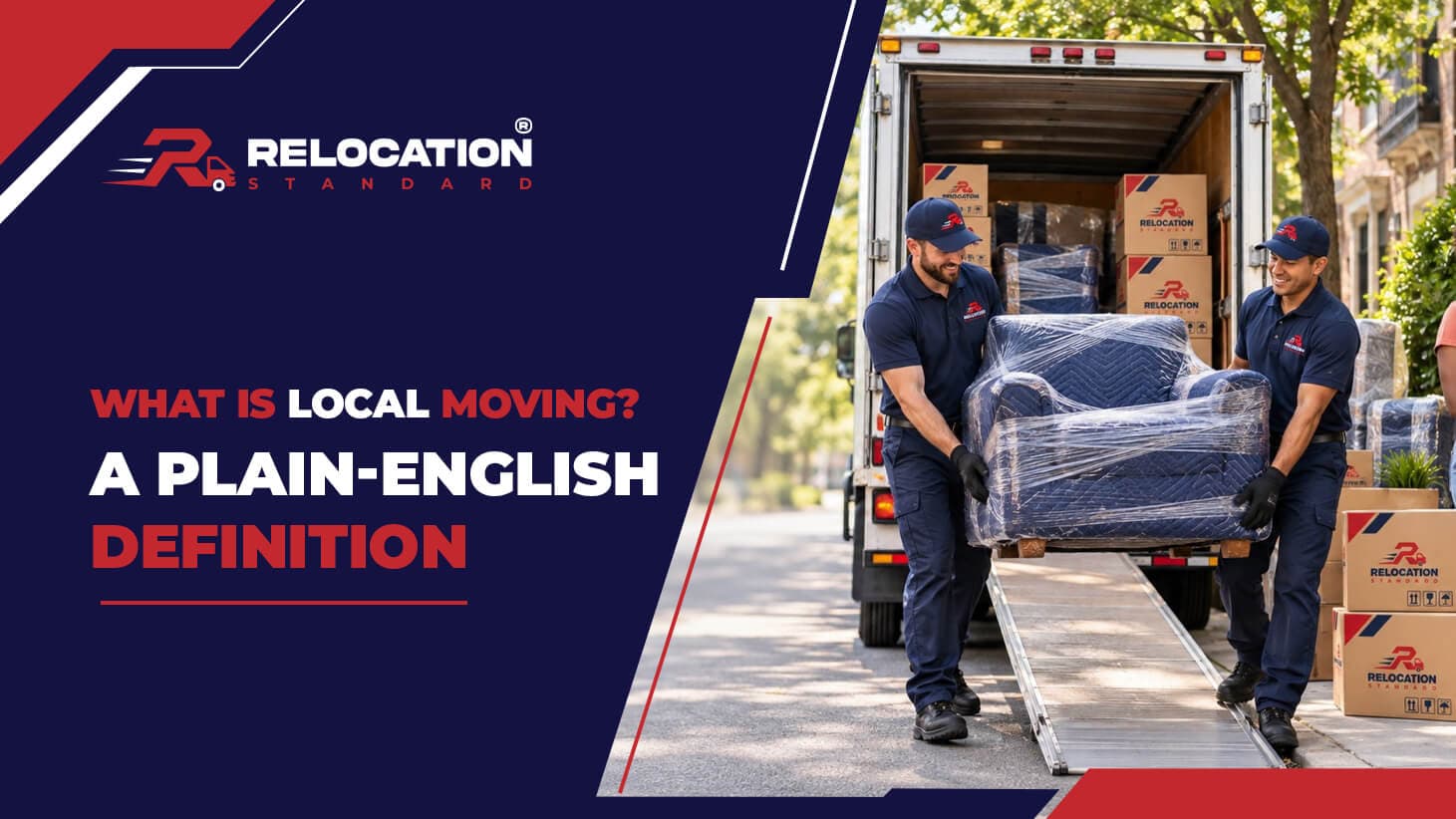
What Is Local Moving?
Local moving is the process of transporting household or business belongings over a relatively short distance, typically within the same city, town, or surrounding metropolitan area. A local move is usually completed in one day, although larger homes or difficult access can require more time. Many companies use a threshold of roughly 50 miles; others use 100 miles or different service-area criteria. There is no universal nationwide mileage cutoff for every mover and state.
For example, relocating between Chicago neighborhoods is ordinarily local. Moving to a nearby suburb may also be local, even if it crosses municipal boundaries. But crossing a state line introduces another legal classification: see what interstate moving means. Moving a few hundred miles entirely within one state may be intrastate moving without being local.
How Does a Local Move Work?
Request a detailed estimate
Tell the mover the pickup and delivery addresses, preferred date, number of rooms, anticipated box count, and special items. Mention stairs, elevators, long hallways, truck access, parking restrictions, and whether you need professional packing. A pre-move inventory helps the crew estimate time and equipment.
Choose packing and handling services
You can pack boxes yourself, ask the crew to pack fragile items, or request a full-service move. Confirm whether furniture wrapping, disassembly, reassembly, packing materials, and unpacking are included or priced separately. Keep medication, identification, keys, and essential electronics with you.
Load, travel, and unload
On moving day the crew protects and loads furniture, transports your belongings, and unloads them at the new property. Many local moves are delivered the same day, but traffic, elevator reservations, and larger inventories can extend the schedule. Check items against your own inventory before the crew leaves.
What Services Are Usually Included?
Standard local service commonly means loading, transportation, and unloading. Full-service options may add packing, unpacking, furniture preparation, and material removal. Labor-only movers help load or unload a truck you supply. The scope always depends on the written agreement, rather than the broad label used in an advertisement. Learn about Relocation Standard's local moving services and residential moving options when planning an in-town relocation.
How Much Does Local Moving Cost?
Many local movers charge by the hour based on crew size and time worked; some provide flat-price quotes. The billing method and legal requirements vary by state. You may also face minimum booking periods, travel charges, packing expenses, or separately permitted access fees. Ask the mover which charges begin before arrival and which end after unloading.
| Hypothetical local move | Amount |
|---|---|
| Crew and truck: 5 hours at $180/hour | $900 |
| Travel charge | $75 |
| Packing materials | $60 |
| Illustrative total | $1,035 |
These figures are examples, not market averages or a company quote. Real costs depend on household size, access, crew, timing, location, and contract. Understanding accessorial moving charges is useful when comparing a base quote with an all-inclusive price.
Local vs. Long-Distance, Intrastate, and Interstate Moving
| Term | Core meaning | Example |
|---|---|---|
| Local move | Short-distance relocation | Across Dallas |
| Intrastate move | Entirely within one state | Dallas to Houston |
| Interstate move | Crosses state boundaries or certain routes through another state | New York to New Jersey |
| Long-distance move | Substantial distance, within or between states | California to Texas |
A move can be both local and intrastate. A short cross-border relocation can feel local but legally count as interstate transportation; certain commercial-zone exceptions may affect which federal household-goods provisions apply. Review our separate guide to long-distance moving before booking a longer route.
Who Regulates Local Movers?
Moves performed entirely within one state generally fall under applicable state and local consumer-protection rules. State requirements can address licensing, insurance, estimates, rate structures, and damage claims. The FMCSA generally regulates interstate household-goods transportation; it advises customers moving within one state to check the appropriate state, county, or local agency. State rules may be more specific than the broad industry definition of a local move.
Ask any prospective company for its legal business identity, registration or license where required, written estimate, payment conditions, and valuation or liability terms. An advertised low hourly rate is not a substitute for understanding the complete agreement.
How Can You Make a Local Move Easier?
- Sort and donate belongings before the estimate so the crew arrives with an accurate plan.
- Label boxes by room and keep daily essentials separate from the truck.
- Reserve elevators, loading docks, and parking where necessary.
- Photograph valuable furniture and report fragile or bulky items early.
- Compare at least two or three written quotes covering the same work.
- Confirm the final bill calculation, including minimum hours and any extra fees.
Final Thoughts
Local moving means relocating over a short distance, but the total effort depends on the inventory, building conditions, and service package. Compare complete written estimates rather than hourly rates alone. For support with a nearby relocation, review local moving services and request a route-specific estimate.