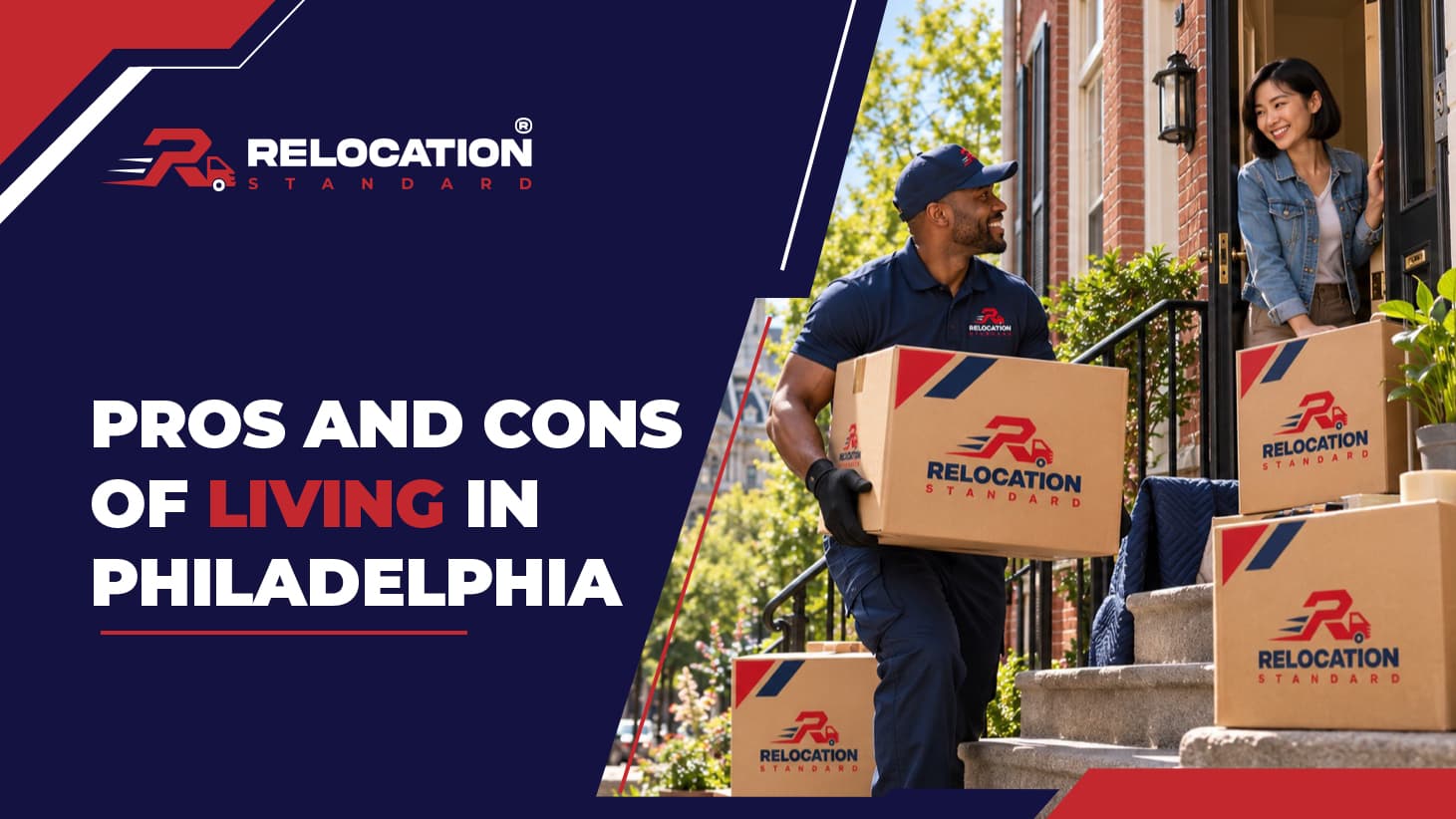
Maybe a hospital or university in Philly has offered you a job. Or New York rent has finally pushed you to look about 100 miles south. You love the idea of row-house blocks and corner bars, but you keep hearing about the wage tax and the crime. These pros and cons of living in Philadelphia show you what daily life costs and feels like before you sign a lease.
Philadelphia suits people who want a walkable city with real neighborhoods, history and food for less than other East Coast hubs. It is a harder sell if you hate city taxes, need a big yard or want a spotless, quiet city.
Philadelphia Pros and Cons at a Glance
Philadelphia gives you 15 clear advantages and 13 real drawbacks. The pros start with big-city life at a lower cost than nearby giants. History on almost every block, walkable streets and wide transit coverage add to the pull.
A central East Coast spot puts New York, Washington, the shore and the mountains within reach. Food, museums, murals, parks, festivals and loud sports fans fill your free time. Big hospitals, universities and headquarters anchor the job base, and kids have plenty to do.
The city is also getting safer and less poor, and its neighborhoods each have their own feel. Those trends make the Philly of 2026 a different place from the one in older headlines.
The cons start with taxes, led by the city wage tax and an 8% sales tax. Traffic, parking, transit funding fights and crowded streets follow close behind. Cold winters, humid summers and uneven safety test many newcomers.
Public schools vary widely, and rents keep rising. Old row houses, litter, aging pipes, odd liquor rules and a sluggish job market round out the list.
15 pros
Pros of Living in Philadelphia
Philadelphia's main advantages are lower costs, deep history, easy transit and a huge amount to do. The list starts with your budget and moves out from there.
1. Big-City Living Costs Far Less Than in New York
Philadelphia gives you the jobs, culture and transit of a major city at a much lower price than its East Coast neighbors. A typical asking rent ran about $1,901 a month in April 2026. To rent comfortably, a household needs about $76,000 a year, slightly below the national figure.
The gap with New York is large. A New York renter needs about $136,000 a year, and a New York buyer needs about $200,000. In Philadelphia, a buyer needs about $108,000 a year to afford a typical home. One cost index puts New York's overall living costs 72.5% above the national average, while Philly sits close to it.
Estimates for Philly's own costs run from about 2% to 4% above the national average. Utilities run about 7% higher and transportation about 5% higher. Healthcare and groceries cost a little less than average, so the savings show up most in housing rather than daily bills.
Home price figures vary a lot by source and area. Census data puts the median value of a city home at about $243,100. One city index sat near $232,000 in September 2026. A broader index that counts more of the region puts the typical value near $387,000. Some guides quote average prices above $500,000, which high-end sales pull up.
So budget off the neighborhood, not the citywide number. Older row houses in Fox Chase, Bustleton and Manayunk still sell for much less than new builds near Center City. Homes in New York, Boston and Washington often cost more than twice as much.
One warning before you celebrate. The wage tax takes part of the savings back, as the cons explain. Compare your total costs, taxes included, before you decide that Philly is cheaper for you.
2. History Is on Almost Every Block
Philadelphia is where the United States began, and you live with that history every day. Delegates signed the Declaration of Independence at Independence Hall in 1776 and the U.S. Constitution there in 1787. The Liberty Bell sits right across the street.
William Penn founded the city in 1682, and it grew into one of the biggest shipbuilding centers on the East Coast. It also served as the nation's capital from 1790 to 1800. Philly calls itself a city of firsts, with the country's first hospital, first university, first library and first zoo.
You do not need a museum ticket to feel it. Old City has cobblestone streets and 18th-century homes. Elfreth's Alley ranks among the oldest continuously lived-in residential streets in the nation, and Society Hill keeps many colonial buildings. The Betsy Ross House sits a short walk from the main sites.
The museums go deeper. The Museum of the American Revolution has thousands of artifacts and live performances. The National Constitution Center shows rare documents in hands-on galleries. The African American Museum in Philadelphia tells the stories of people of African descent through art and history.
The city marked the 250th anniversary of the Declaration in 2026 with a free unity concert on the Parkway on July 4. Big anniversaries bring crowds, though. Old City fills up in summer and on holidays, so locals run errands there early or on weekdays.
3. You Can Walk and Bike to Most Things
Getting around on foot is easy here, because Philadelphia ranks among the most walkable big cities in the country. It has a Walk Score of 75 out of 100 and ranks as the eighth most walkable big city in the nation. In many neighborhoods, groceries, cafes and parks sit within a few blocks of home.
Center City sits on a compact grid, and row-house blocks keep corner shops close to homes. About 7% of residents walk to work, and nearly 2% bike. That is a real share for an American city.
Cycling keeps getting easier. The city has a Bike Score of 67, with Indego bike-share stations across town and hundreds of miles of trails. One ranking put Philly sixth in the nation for bikers. New bike lanes and greenways give riders, skaters and walkers more safe routes each year.
Narrow streets in older areas can make riding feel tight, so pick routes with protected lanes. If you choose a home near your daily stops, you can drop a car payment and parking costs altogether. Plenty of residents never own a car here.
4. Transit Reaches Most of the Region
Philadelphia has one of the widest transit networks in the country, and SEPTA runs it. It includes buses, trolleys, two subway lines, regional rail and a high-speed line across five counties. Trains also reach the airport, Delaware and New Jersey.
The Market-Frankford Line and Broad Street Line link Center City, Fishtown and University City. The base fare is $2.90 for a bus or subway ride, and your first two transfers within two hours are free. Riders 65 and older can also use a SEPTA shared-ride program.
The PATCO line links Center City with South Jersey towns like Haddonfield and Collingswood. Regional rail reaches suburbs and nearby cities such as Trenton and Wilmington. A redesigned bus network began rolling out in August 2026, with more phases set for 2027.
About 20% of residents take transit to work. The average commute runs about 33 minutes, compared with about 41 minutes in New York. Many renters choose an apartment by its distance to a subway stop.
The catch is reliability and funding, which the cons cover. Check bus and train frequency near any home before you sign. Keep a backup route in mind, such as regional rail or a bike.
5. New York, Washington and the Shore Are Close
New York and Washington both make easy day trips, because Philadelphia sits right between them. Trains reach either city in about 1.5 to 2 hours, while a drive takes about 2 to 3 hours with traffic.
Amtrak service from 30th Street Station links you to the whole Northeast Corridor. Baltimore sits about 89 miles away, roughly a two-hour drive. Philadelphia International Airport adds direct flights for longer trips.
Nature is close too. Ocean City and the rest of the Jersey Shore sit about 1.5 hours away, and the Pocono Mountains take about 2 hours. Amish country in Lancaster County is about an hour's drive, and Rehoboth Beach makes a longer summer trip.
This location lets you keep family and career ties along the East Coast without paying East Coast rents. Summer shore traffic can stretch drive times, so leave early on Fridays.
6. Food Goes Far Beyond Cheesesteaks
Philadelphia has one of the best food scenes on the East Coast, and it costs less than New York's. Cheesesteaks have been a local staple since the 1930s. Pat's King of Steaks and Geno's Steaks still face off in South Philly, and Sonny's Famous Steaks draws its own fans.
Reading Terminal Market fills a downtown block with food stalls and grocers. Water ice, soft pretzels and tomato pie are local favorites. Termini Bros Bakery turns out fresh Italian pastries.
The range keeps going. You will find Ethiopian, Filipino, Vietnamese and Mexican food, plus Suraya, a Lebanese restaurant and market in Fishtown. Zahav serves Israeli dishes, and Kanella covers Mediterranean food. For a big night, Friday Saturday Sunday, Provenance and Her Place Supper Club hold Michelin stars.
Pennsylvania's liquor rules created a big BYOB culture. Many restaurants let you bring your own wine or beer, so you skip the restaurant markup entirely. Keep a bottle at home, and dinner out costs less than you expect. Food events like the Philadelphia Taco Festival add to the mix.
7. Museums, Art and Murals Fill the City
Philadelphia has world-class museums and more public art than almost any American city. The Philadelphia Museum of Art holds European, East Asian and American collections, and the Rocky steps sit out front. The Barnes Foundation shows works by van Gogh, Monet and other impressionists.
The African American Museum in Philadelphia opened in 1976 as the first museum of its kind in a major U.S. city. The Rodin Museum has outdoor gardens full of sculpture. The Institute of Contemporary Art covers newer work, and the Mutter Museum shows medical history.
Public art fills the streets. More than 4,000 murals cover walls across the city, which earned it the title of Mural Capital of America. Magic Gardens on South Street turns tile and glass into a walk-through art space.
Performing arts round it out. Ensemble Arts Philly brings Broadway shows and concerts by The Philadelphia Orchestra. The Mann Center hosts summer concerts in Fairmount Park. A museum membership pays off fast if you live here, so pick one or two favorites and use them often.
8. Parks and Green Space Are Easy to Reach
Green space is easier to reach here than in most big cities. Fairmount Park alone spans about 4,200 acres, one of the largest urban parks in the country. It holds the zoo, the Mann Center, colonial-era mansions, gardens and horseback riding trails.
Wissahickon Valley Park adds wooded trails and creek views in the northwest. On the water, Schuylkill Banks offers kayaking, fishing and riverboat tours. Spruce Street Harbor Park on the Delaware has hammocks, food and river views in summer.
Smaller squares bring green space into dense blocks. Rittenhouse Square, Washington Square, Franklin Square and Dilworth Park each act as a neighborhood living room. Clark Park gives West Philadelphia its own green spot. The flag-lined Benjamin Franklin Parkway leads up to the art museum.
The city's trail plan aims to link more neighborhoods with greenways over time. Access still varies, so check a map for the nearest park before you sign a lease. A home near the Wissahickon or the river trails changes how your weekends feel.
9. Festivals and Live Music Fill the Calendar
Philadelphia keeps a full calendar of festivals, parades and live shows. The 9th Street Italian Market Festival and the Rittenhouse Row Spring Festival fill the streets in May. The Roots Picnic kicks off that same month, and the Philadelphia Folk Festival follows in August.
Winter has its own traditions. Christmas Village brings holiday shopping to LOVE Park in Center City. The Mummers Parade turns New Year's Day into a costumed street party. The Philadelphia Flower Show fills the convention center every year.
Live music runs year-round. Chris' Jazz Cafe and South Jazz Kitchen cover jazz, and Johnny Brenda's hosts indie and punk bands. Underground Arts and World Stage Live book local and touring acts. You can find a show on almost any night.
Big events close streets and pack trains, so check the schedule before you drive. Neighborhood groups host smaller street fairs, too. Showing up at one is an easy way to meet the people on your block.
10. Sports Fans Are Loud, Loyal and Close to the Action
Sports run deep here, and Philadelphia fans rank among the most passionate in the country. The Eagles play at Lincoln Financial Field and the Phillies at Citizens Bank Park. The 76ers, Flyers and the Wings lacrosse team share Xfinity Mobile Arena.
Most of these venues sit together in South Philadelphia, close to the Broad Street Line. You can take the subway to a game and skip the parking lot. The Union play soccer at Subaru Park, just south of the city in Chester.
The city also hosts world-class events. Lincoln Financial Field held six FIFA World Cup matches in summer 2026. Citizens Bank Park hosted the MLB All-Star Game that July, and the region also hosted the PGA Championship.
Fan culture here runs hot, and game days shape the mood of the whole city. Tickets for big games can cost a lot, so look for weeknight deals. Avoid driving near South Philly before kickoff if you can.
11. Hospitals and Big Headquarters Anchor the Job Market
Philadelphia has a deep base of jobs in healthcare, education, finance and life sciences. Children's Hospital of Philadelphia ranks among the top children's hospitals in the nation. Penn Medicine and the city's university hospitals add thousands more medical jobs.
Big companies keep their headquarters here. Comcast and Aramark are the city's two Fortune 500 companies. Vanguard runs large offices in the region, and Urban Outfitters, Inc. owns brands like Anthropologie and Free People.
The growth numbers look solid. Jobs in Philadelphia grew about 13.6% from 2020 to 2024, faster than in Los Angeles, Chicago or Dallas. Metro jobs grew about 1.9% from August 2024 to August 2025, ahead of New York's 1.4%.
Healthcare, research and education workers will find the most openings. Life sciences, technology and advanced manufacturing are growing, too. Weigh any offer against the wage tax, which comes up first in the cons.
12. Universities Sit a Few Subway Stops Apart
College campuses are everywhere, and Philadelphia has one of the largest college populations in the country. The University of Pennsylvania ranks seventh among national universities and runs 12 schools on one campus. Drexel is a major research university, and nearby Villanova adds another well-known name. Many graduates stay in the city after school, which keeps the population younger.
Temple University enrolls more than 30,000 students across 600-plus programs, about 15 minutes from Center City. La Salle, Thomas Jefferson University and the Community College of Philadelphia add even more choice. Many of these campuses sit just a few subway stops from each other.
For you, that means classes, lectures, sports and campus events close to home. Grad students and career changers can study without moving again. Kids who grow up in Pennsylvania qualify for in-state tuition at the state's public universities. Campus neighborhoods also bring student crowds and higher rents near Penn, Drexel and Temple.
13. Kids Have Plenty to Do
Philadelphia gives families a long list of hands-on things to do. The Philadelphia Zoo was America's first zoo, and it has bald eagles, red pandas and pumas. The Please Touch Museum invites young kids to play with every exhibit.
The Franklin Institute is a favorite for older kids, with a giant walk-through heart and science shows. Magic Gardens lets kids see mosaic art up close. In winter, families skate at the Independence Blue Cross RiverRink and Dilworth Park.
Parks add free options. City parks host puppet shows and music in warm months. The trade-off for families is schools, which vary a lot by address and get their own con below. Many families pair city weekends with a close look at school options before they pick a home.
14. Crime and Poverty Are Falling Fast
Philadelphia has made big gains on its toughest problems in the past few years. The city recorded 222 homicides in 2025, its lowest total since 1966. That count fell from a record of more than 560 in 2021, a drop of more than 60%.
Shootings dropped below 1,000 in 2025 for the first time in more than 20 years. Overdose deaths kept falling, to an estimated 1,000. The poverty rate fell below 20% in 2024, so Philly is no longer the poorest of the largest U.S. cities.
The trend continued into 2026. By October 2026, violent crime was down about 4% from a year earlier and property crime about 8%. Homicides were down another 22%.
Residents feel the change. In a 2025 poll, 59% said the city was heading in the right direction, up from 36% in 2022. The city you move to today is safer than the one in older headlines. Gains still vary by neighborhood, as the safety con explains.
15. Neighborhoods Have Real Character
Locals call Philadelphia the City of Neighborhoods, and each one has its own feel. The city has about 25 main neighborhoods and more than 150 smaller ones. You can find luxury towers, old row houses and quiet tree-lined streets inside the same city limits.
Fishtown and Northern Liberties draw young buyers with street art, music venues and new shops. Bella Vista has a strong community feel near the Italian Market. Rittenhouse offers upscale living, while Queen Village draws families. About 38% of residents are Black and about 16% are Hispanic. You can taste that mix in the food from one area to the next.
Fairmount offers quieter streets close to the art museum. University City centers on Penn and Drexel, Chinatown packs in food and culture, and Manayunk has a bohemian streak. Fox Chase and Bustleton in the Northeast offer lower prices.
That range lets you match a block to your budget and habits. Prices, parking and safety can shift a lot within a few blocks, though. Visit at night and on a weekend before you sign anything.
That is a long list of reasons people choose Philly over pricier East Coast cities. The city also asks a lot of you in return, starting with your paycheck.
13 cons
Cons of Living in Philadelphia
The main disadvantages of living in Philadelphia are high city taxes, heavy traffic, uneven safety and schools, and aging homes and streets. Each one below comes with a way to soften it.
1. The City Wage Tax Takes a Bite From Every Paycheck
Philadelphia charges one of the highest local income taxes in the country. As of July 1, 2026, the wage tax is 3.735% for residents and 3.425% for nonresidents who work in the city. Pennsylvania adds a flat 3.07% state income tax on top.
On a $75,000 salary, the city wage tax alone comes to about $2,800 a year. Your employer withholds it from each paycheck before you see the money. Nonresidents who work in the city still pay, so a suburban home alone does not erase the tax.
The rate drops a little each July, but the cuts are small. It fell from 3.74% to 3.735% for residents in 2026. Many residents feel the tax buys too little in return, and it ranks among the most common complaints about city life.
Build the wage tax into any salary comparison. A suburban job plus a suburban home avoids it, which is why some families leave once their kids reach school age. Check your first pay stub to confirm your employer withholds the right rate.
2. Property, Sales and Soda Taxes Add Up
Philadelphia stacks several other taxes on top of the wage tax. The real estate tax rate is 1.3998% of assessed value, unchanged since 2016. The city and the school district split that rate between them.
Sales tax is 8%, which combines the state's 6% and a 2% city rate. The city also taxes sweetened drinks at 1.5 cents per ounce, diet soda included. You will see that tax in the shelf price of many drinks.
Homeowners got new 2027 valuation notices in 2026, and bills follow assessed values. Every owner who lives in the home qualifies for the Homestead Exemption, which lowers the taxable value. Income-based programs can freeze bills or spread them into installments.
Check the assessed value of any home before you buy. Apply for the Homestead Exemption as soon as you move in. Then budget a little more for groceries and drinks than you would in a low-tax state.
3. Traffic and Parking Test Your Patience
Traffic here ranks among the worst in the world. In 2025 it ranked third in the nation and fifth worldwide for congestion. The average driver lost about 101 hours to traffic that year.
The Schuylkill Expressway, I-95, I-676 and Roosevelt Boulevard jam up at rush hour. About 13% of commuters spend an hour or more getting to work. Constant roadwork adds surprise delays, and suburban commutes often run longer than the 33-minute city average.
Parking is just as hard. Permit zones, meters and confusing signs cover much of Center City, University City and the historic districts. Garages can charge $20 to $30 a day. The Philadelphia Parking Authority writes tickets fast.
Live near your work or a train line if you can. Get a residential parking permit if your block offers one. Read every sign before you park, because one missed rule can cost you a ticket.
4. Transit Funding Fights Keep Coming Back
SEPTA has faced repeated budget crises that put service at risk. In June 2025, its board voted to cut service by 20% and drop 32 bus routes. A court order in September 2025 halted further cuts and restored the service already cut.
The base fare still rose from $2.50 to $2.90 that month. The state then approved $394 million in capital funds to keep buses and trains running through July 2027. That money buys time, but it is not a lasting fix.
Riders also deal with delays, packed trains at rush hour and slowdowns in heavy snow. Aging equipment and stations need costly repairs that compete for the same money. Young workers in a 2026 focus group named unreliable service as a top frustration.
Do not assume your bus route will look the same next year. Watch for service news before you choose a home that depends on one line. A home near both a subway stop and a regional rail station gives you a fallback.
5. Crowds and Density Wear on Some People
Philadelphia is a dense city, and you feel it on sidewalks, trains and roads. About 1.57 million people live in roughly 135 square miles. Its density sits on par with Chicago's.
Center City, North Philly, West Philly and parts of the Northeast stay busy most of the day. Sidewalks fill at lunch, and SEPTA buses and trains pack in at peak hours. Rush hour on I-95 feels crowded in a different way.
Some people love the energy. Others find it draining after years in a suburb or small town. If you want more room and a quieter pace, look at Northwest neighborhoods, the Northeast or the inner suburbs. You trade a longer trip into Center City for more space.
6. Winters Are Cold and Summers Are Humid
Philadelphia has four real seasons, and two of them can be rough. Winter averages about 37 degrees, and January lows dip to about 26. Snow totals run about 13 to 21 inches a year, depending on the source and the winter.
Ice storms and nor'easters can shut down roads and slow transit. Short, gray winter days wear on some newcomers who come from sunnier places.
Summers average about 77 degrees, and July highs reach about 87. Humidity makes it feel worse, and heat waves push temperatures into the 90s. The city canceled its July 3, 2026 parade because of extreme heat. Summer also brings about 15 inches of rain.
The Delaware and Schuylkill rivers can flood nearby streets after storms, high tides or fast snowmelt. Budget for a real winter coat, boots and good air conditioning. Sign up for ReadyPhiladelphia alerts, and check flood maps before you buy near either river.
7. Safety Still Varies Block by Block
Crime has dropped fast, but Philadelphia still has more crime than most American cities. Its violent crime rate has long run above the national average. One index rates the city safer than only about 1% of U.S. cities.
Crime does not fall evenly across the city. Kensington remains the center of the city's opioid crisis. Some residents say violent crime has crept into once-calm areas like Rittenhouse Square. Property crimes like package theft and break-ins still worry many people.
The city is pushing back. Its P.I.E. strategy pairs targeted policing with community programs and social services to reduce violence. The results show in the falling homicide and shooting counts from the pros.
Some of the safest areas sit in the Northeast and Northwest. Wissahickon Park, Bustleton and Pennypack Park often top safety lists. Study crime maps for the exact blocks you are considering, and visit at night before you sign. Lock bikes and bring packages in fast.
8. Public Schools Vary Widely
Philadelphia's public schools range from nationally ranked to deeply struggling. The district runs about 330 schools serving nearly 200,000 students. One rating service gives the system a C minus overall.
Budget shortfalls have led to cuts in classroom resources, after-school programs and staff over the years. Many school buildings are old and need repairs. Test scores and graduation rates vary a lot from school to school.
Bright spots exist. Julia R. Masterman ranks eighth among public high schools in the nation. Some families choose magnet, charter or private schools, and others look at suburban districts such as Radnor Township.
Research the exact school tied to any address before you fall for the house. Magnet and charter schools have deadlines and waitlists, so start early. If schools come first for you, compare a few suburbs against city options before you buy.
9. Rents Are Rising While Others Fall
Philadelphia rents keep climbing even as many other cities cool. One tracker put the median rent at $1,447 in July 2026, up slightly from a year earlier. Over the same period, the national median fell about 1%.
Other figures run higher because they count newer or larger units. A one-bedroom averages about $1,850 a month, and a two-bedroom about $2,350. Some guides quote averages above $2,100. City housing costs rose about 4.5% in the year to October 2025.
Locals describe a tight market where landlords raise prices on the few open units. Some once-cheap neighborhoods have seen the sharpest price jumps. Buying is not cheap either, since a buyer needs about $108,000 a year, 11% above the national figure.
Start your search early and move fast on good units. Compare rent in several neighborhoods, and ask landlords about past increases before you sign. If you plan to stay five years or more, run the numbers on buying an older row house.
10. Old Row Houses Mean Close Quarters and Repairs
About 70% of Philadelphia homes are row houses, so you will likely share walls with your neighbors. You may hear music, footsteps or conversations through them. Many homes have small patios rather than lawns.
Most of these homes are more than 50 years old. Old wiring, plumbing and roofs can bring big repair bills. Older homes in areas like Fairmount and Society Hill can need more upkeep than newer builds.
Narrow staircases and small rooms make big furniture hard to move in. Parking and storage space run tight on many row-house blocks. Measure doorways and stairs before you buy a sectional.
There is help and an upside. The city's Neighborhood Home Preservation Loan Program offers low-interest loans for repairs. Close quarters also help many blocks build tight communities where neighbors look out for each other. Get a full inspection before you buy any older home.
11. Litter, Potholes and Old Pipes Frustrate Residents
Many residents name litter and illegal dumping as one of the worst parts of city life. Locals say the problem has grown over the years. Trash bags, loose debris and dumped items show up on some blocks.
Streets show their age, too. Potholes and constant roadwork slow drivers and riders. Under the street, some cast iron water mains date back to between 1812 and 1879.
The city sees several hundred water main breaks a year, and they peak in January, its coldest month. Crews usually fix them fast. Some cause water shut-offs, iced streets, sinkholes or flooded basements and cars.
The city runs expanded trash pickup, graffiti removal and cleanups like Philly Spring Cleanup and Love Your Park. Cleanliness still changes block by block. Walk the blocks near any home on trash day, and join a block cleanup if you want to meet neighbors.
12. Liquor Rules Can Confuse Newcomers
Pennsylvania has some of the strictest alcohol rules in the country. Since the end of Prohibition in 1933, the state has decided where stores may sell each type of drink. Hard liquor comes from state-run Fine Wine and Good Spirits stores and some distilleries.
Some grocery stores and other retailers also sell wine. Beer is easier to find than it once was. You can buy it at supermarkets, convenience stores and beer distributors, and bars sell six-packs to go.
The state also caps liquor licenses, so a license can cost a restaurant hundreds of thousands of dollars. That limits how many places can serve drinks. Pennsylvania let approved Philly bars stay open until 4 a.m. during the 2026 World Cup, but that change was temporary.
Learn where to buy each type of drink before your first party. The upside is the BYOB culture from the pros. Bring your own bottle to dinner, and the rules start to work in your favor.
13. The Job Market and Pay Lag Behind Other Gains
Philadelphia's job market has not kept pace with its other gains. City unemployment rose to 5.1% in 2025, its highest level since 2021. Metro figures eased to about 4.4% to 4.9% by mid-2026.
Pay is a common complaint. The city's median household income was about $60,500 in 2024, far below a broader area figure of about $96,400. In a 2026 focus group, young residents said jobs were plentiful in healthcare and law. They found fewer openings in tech, finance and the arts, and lower pay than in other East Coast cities.
The population has also slipped. The city counted about 1,574,000 people in 2025, down from about 1,604,000 in 2020. It did gain about 1,500 residents from 2024 to 2025, so the decline may be leveling off.
Try to line up a job before you move, or bring a remote one. Healthcare, education and life sciences offer the most openings. Many roles fill through local contacts, so start networking early.
Who Philadelphia Suits and Who Should Think Twice
Philadelphia suits people who want a big, walkable city without New York prices. It frustrates people who want low taxes, easy parking and quiet streets. You will likely do well here if you love history, food, museums and loud sports crowds. It also fits healthcare, research and education workers who want strong employers.
Young professionals find lively neighborhoods and good transit. Commuters to New York or Washington gain a cheaper home base. Students and grad students find top universities a few subway stops apart.
Think twice if city taxes, traffic or parking would wear you down. The same goes if you want a big yard, a spotless street or a quiet suburban feel. Families should research schools closely before they choose a neighborhood.
For other East Coast options, see the pros and cons of living in New York. The pros and cons of living in Washington, DC are worth a look too. You can also compare the pros and cons of living in Baltimore and the pros and cons of living in Boston.
The Bottom Line on Living in Philadelphia
Philadelphia is worth it if you want a real big city at a lower cost than its East Coast neighbors. You get history, food, museums, parks, transit and a central location. Crime has also fallen fast in recent years.
Look elsewhere if the wage tax, traffic, old homes and uneven schools would wear you down. If you are on the fence, spend a weekend in a few neighborhoods first. Then rent for a year to learn which part of the city fits you best.
If you decide to go, our Philadelphia movers handle apartments and full row houses. Our residential moving services cover moves of every size. We also run interstate moving services and long-distance moves.
Along the East Coast, we plan moves from New York City, Washington, DC and Baltimore. We also cover in-state moves to Pittsburgh and plan long-distance moves out of Chicago.
Service members can use our military moving services. Get a free, no-obligation moving quote or contact our team.